
Screen Cables Manufacturer
MEM Industries manufactures Screen Cables for electrical systems where signal quality can be affected by unwanted electrical interference. These cables are particularly useful in instrumentation, control, automation and monitoring circuits where the cable needs to carry relatively sensitive signals through electrically active industrial environments.
Where Screen Cables Make a Difference
Screening becomes particularly useful when signal circuits run close to equipment that generates electrical noise. Typical examples include:
- Variable-frequency drives and motor control equipment
- PLC and automation panels
- Process instrumentation
- Temperature and measurement circuits
- Industrial monitoring systems
- Control and communication installations
- Manufacturing machinery
- Power and process plants
The objective is not simply to add another protective layer; the screen construction, grounding method, cable routing and installation practice all influence the effectiveness of the finished circuit.
Designed for More Than One Industrial Environment
MEM Industries’ Screen Cable range can be configured for different operating conditions, including oil, moisture, chemicals, corrosion, UV exposure and elevated temperatures. Special constructions such as flexible, low-capacitance and fire-survival signal cables are also available depending on requirements.
Built Around Signal Protection
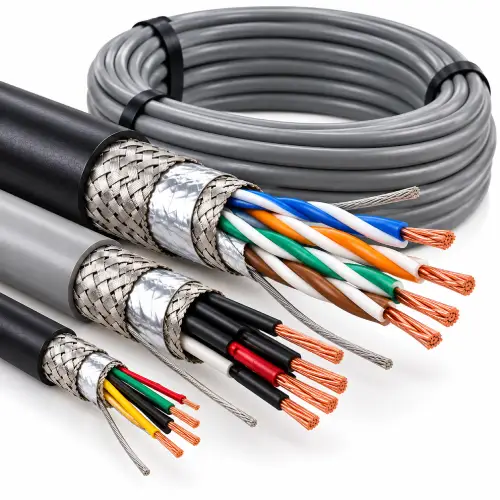
A Screen Cable incorporates a conductive screening layer around the insulated conductors. This screen acts as a barrier against electromagnetic interference and can be connected appropriately to ground through the drain wire or designated termination arrangement.
MEM Industries can provide different screening constructions, including Aluminium-Mylar tape with drain wire and annealed tinned copper wire braiding, with individual-pair, overall or combined screening depending on the cable design.
Construction Options from MEM Industries
MEM Industries can offer Screen Cable constructions based on the requirements of the installation. Available configurations include:
Cable Element | Available Options |
Conductor | Annealed bare copper / tinned copper |
Conductor Form | Solid / suitable stranded construction |
Conductor Size | Approximately 0.50–2.5 sq.mm for signal cable configurations |
Core Arrangement | Pairs / triads / multicore |
Screening | Aluminium-Mylar + drain wire / tinned copper braid |
Screen Arrangement | Individual, overall or individual + overall |
Insulation | PVC / PE / XLPE / PTFE / FEP and other suitable materials |
Armouring | Galvanized steel / stainless-steel options where specified |
Outer Sheath | PVC / FRLS / LSZH / PTFE / FEP / other application-specific options |
Voltage Grade | Available up to 1100 V depending on construction |
These specifications are configuration-dependent; the final cable should be selected against the electrical, environmental and mechanical requirements of the installation.
A Cable Selection That Starts With the Signal
For Screen Cables, selecting only the conductor size is not enough. Important considerations include:
- Type of signal – analogue, control, instrumentation or communication.
- Interference environment – proximity to motors, drives, transformers and switching equipment.
- Screen construction – tape, braid, individual screen or overall screen.
- Grounding arrangement – determined by the system design and installation practice.
- Temperature exposure – insulation must match the operating environment.
- Chemical and moisture exposure – sheath material can be selected accordingly.
- Mechanical conditions – armoured or specially protected constructions may be appropriate.
This application-led approach helps avoid selecting a cable merely from a catalogue description.
Screened Cable Options for Instrumentation and Control
Screened cables are widely suited to circuits where maintaining signal integrity is important. Pair and triad constructions can be used for measurement and instrumentation circuits, while multicore screened configurations can serve control and monitoring requirements.
For specific instrumentation constructions, MEM Industries lists conductor sizes from 0.50 to 2.5 sq.mm and configurations extending up to 48 pairs/triads, subject to the selected design.
Why Specify MEM Industries Screen Cables?
- Multiple screening arrangements
- Pair, triad and multicore constructions
- Different insulation and sheath choices
- Armoured and unarmoured variants
- Options for harsh industrial environments
- Support for application-specific cable requirements
- Suitable configurations for control and instrumentation systems
- Bulk and project-oriented supply
Electrical Characteristics
For selected Screen Cable constructions, published characteristics include conductor resistance, mutual capacitance, insulation resistance and high-voltage test values. For example, the listed conductor resistance at 20°C ranges from 39.70 Ω/km for 0.50 sq.mm to 7.41 Ω/km for 2.5 sq.mm in the referenced configuration.
Conductor Size | Conductor Resistance at 20°C |
0.50 sq.mm | 39.70 Ω/km |
0.75 sq.mm | 26.50 Ω/km |
1.00 sq.mm | 18.60 Ω/km |
1.50 sq.mm | 12.30 Ω/km |
2.50 sq.mm | 7.41 Ω/km |
Values apply to the referenced cable configuration and should not be treated as universal specifications for every Screen Cable construction.
Made for Industrial Signal Routes
Screen Cables from MEM Industries can be considered for electrical and instrumentation networks in:
- Steel and metal plants
- Power generation facilities
- Chemical processing units
- Petrochemical installations
- Manufacturing plants
- Industrial automation systems
- Process-control installations
- Defence and specialised engineering applications
MEM Industries states that it has manufactured speciality cables and wires since 1995, serving demanding users including steel plants, power plants, defence and high-technology industries.
Screen Cables for Your Specific Installation
There is no single Screen Cable construction suitable for every industrial circuit. The correct choice depends on signal type, conductor size, screening arrangement, voltage, temperature, environment, mechanical protection and installation method. Share your required number of pairs/cores, conductor size, voltage, screen type, insulation, sheath and quantity with MEM Industries to discuss a suitable Screen Cable configuration and obtain a quotation.